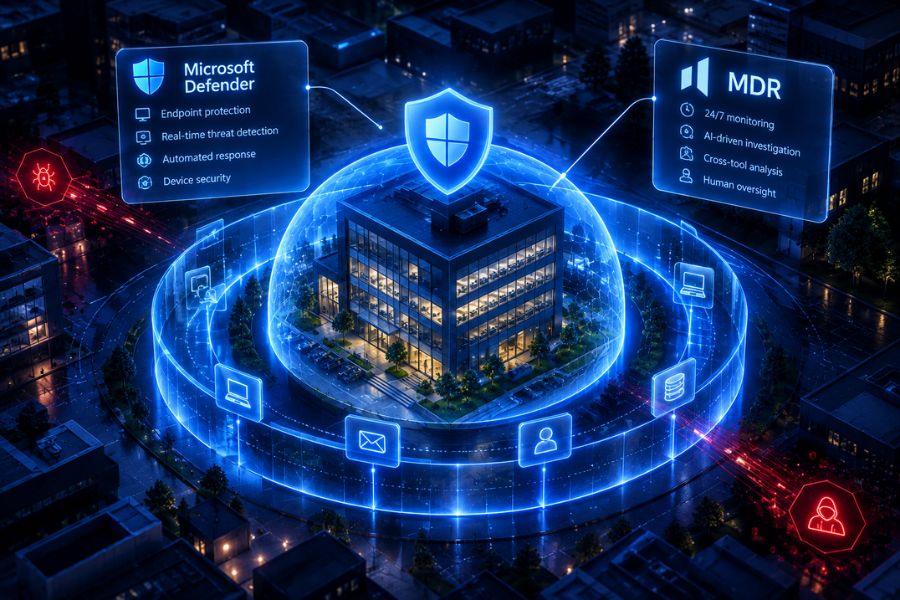
MDR vs MSSP comes down to who investigates threats, who responds, and how much work stays with your team. A managed security service provider (MSSP) runs a broad range of outsourced security services and often escalates alerts back to you. A managed detection and response (MDR) provider focuses on investigating and containing threats for you. Agentic MDR delivers the MDR model with AI analysts doing the investigation, while people approve high-risk actions.
For a growing business with limited IT resources, the right choice depends on what you already have and which responsibilities you need to hand over. This guide compares four models: an MSSP, traditional MDR, Agentic MDR and an in-house security operations centre (SOC).
The short answer:
- Choose an MSSP if you want to outsource a wide range of security work, such as firewalls, device management, monitoring and reporting, and you have people who can act on what it escalates.
- Choose MDR if you need threats investigated and contained for you, around the clock.
- Choose Agentic MDR if you are a lean team that needs MDR-level investigation across the tools you already own, with people approving high-risk actions.
What Is an MSSP?
A managed security service provider (MSSP) is a company that delivers outsourced security services to other organisations. Typical services include firewall and network security management, endpoint protection, vulnerability scanning, security monitoring and compliance reporting.
Some MSSPs also offer MDR. The scope depends on the contract: many MSSP agreements cover monitoring and alerting, but leave investigation and response decisions to your team.
What Is MDR?
Managed detection and response (MDR) is a service that combines continuous security monitoring, investigation and response, so organisations can find and act on threats without relying entirely on an internal security operations centre (SOC).
An MDR provider typically delivers 24/7 security monitoring, investigates suspicious activity across endpoint, identity, email and cloud tools, and helps contain confirmed threats. Our guide to how MDR works explains the process step by step.
MDR vs MSSP: What Is the Difference?
The core difference is depth versus breadth. An MSSP manages a wide range of security functions. An MDR provider goes deep on one: detecting, investigating and responding to threats.
In practice, the difference shows up in four places:
- What happens to an alert: An MSSP often forwards or escalates alerts. An MDR provider investigates them and tells you what happened.
- Who responds: Under many MSSP contracts, your team takes the response action. MDR providers usually contain threats themselves, within limits you agree.
- Threat hunting: MDR services usually include proactive threat hunting. With an MSSP it varies and is often an add-on.
- Tools covered: MSSPs often manage infrastructure such as firewalls and network devices. MDR concentrates on detection data from endpoint, identity, email and cloud tools.
Whichever you choose, ask who takes responsibility once a genuine threat is identified, and get the answer in writing. The NCSC’s guidance for SMEs on choosing a managed service provider recommends checking that roles, responsibilities and liabilities are clearly defined in the contract, and that it specifies how and when security incidents are notified.
What Changes With Agentic MDR?
Agentic MDR (agentic managed detection and response) is a security service in which AI analysts monitor a business’s systems 24/7, investigate and connect alerts across its security tools, and take action to stop threats, with a person approving anything high-risk.
Compared with traditional MDR, investigation can start as soon as an alert arrives, rather than when an analyst picks it up. Compared with an MSSP that escalates alerts, the investigation is done for you.
For example, an unusual login might trigger an investigation that brings together identity records, endpoint activity and email security signals. Instead of an analyst collecting each piece of information manually, AI analysts do much of that work and hand over a finished investigation. See how Agentic MDR investigates a security incident for a worked example.
The level of autonomy depends on the service and its configuration. HOPLONai’s Governance Gates, for example, let low-risk actions run automatically while high-risk actions wait for human approval.
MDR vs MSSP vs Agentic MDR vs In-House SOC
The table compares the four models side by side.
| Capability | MSSP | Traditional MDR | Agentic MDR | In-house SOC |
| Main focus | Broad outsourced security operations | Detecting, investigating and responding to threats | The MDR model, with AI analysts doing the investigation | Your own monitoring and response |
| Who investigates alerts? | Varies; often escalates them to your team | Human analysts, assisted by automation | AI analysts, with people approving high-risk actions | Internal analysts |
| When investigation starts | Depends on contract and triage policies | When an analyst picks up the alert | As soon as the alert arrives | When someone is available |
| Who takes response action? | Often your team, unless response is included | The provider, or your team after a handover | Low-risk actions run automatically; high-risk ones wait for approval | Internal team |
| Existing security tools | Often its own supported devices | Often the provider’s supported stack | Designed to work across connected tools | Whatever you buy and integrate |
| 24/7 coverage | Depends on contract | Typically included | Continuous AI monitoring and investigation | Needs shift cover: about 4.5 full-time staff or more |
| How costs scale | Service packages and managed devices | Endpoints, users or assets | Varies by provider (HOPLONai: per seat) | Salaries, tools and training |
| Best fit | Outsourcing several security functions | Expert-led investigation and response | Lean teams needing 24/7 investigation without a SOC | Larger organisations needing direct control |
These are typical service models. Actual capabilities, coverage and responsibilities vary by provider and contract.
If you are also weighing up AI SOC platforms, which your own team operates, see Agentic MDR vs AI SOC.
How Do MDR and MSSP Costs Compare?
Pricing models differ more than headline prices:
- MSSPs usually price by service package and the number of devices or sites they manage.
- MDR providers usually price per endpoint, user or asset, sometimes with extra charges for incident response.
- Agentic MDR providers set their own models. HOPLONai, for example, prices per seat.
- An in-house SOC is mostly salaries, plus tools and training.
The in-house arithmetic is simple. A week has 168 hours. At a standard 37.5-hour working week, keeping one analyst on shift around the clock takes about 4.5 full-time people, before holidays, sickness and training. That is why 24/7 in-house coverage is rarely realistic for a lean team.
HOPLONai publishes its prices: per-seat packages from a free tier up to $35 per seat per month, with a 10-seat minimum on paid packages. See HOPLONai pricing for what each package includes.
When Is Traditional MDR or an MSSP Still the Right Choice?
Agentic MDR will not be the best fit for every organisation.
- Traditional MDR may suit you better if you need named analysts, a specific human-led investigation model or specialist incident response. This can matter in highly regulated environments.
- An MSSP may suit you better if you need broader outsourced services, such as firewall management, patching, infrastructure security and ongoing IT administration.
- An in-house SOC may make sense for larger organisations with complex environments, specialist requirements and the budget to staff analysts around the clock.
Many organisations combine models, for example an MSSP for device management and an MDR service for detection and response. If an existing MSSP already delivers effective detection, investigation and response, adding another service may bring limited value.
Which Model Should a Lean IT Team Choose?
You would not be unusual in outsourcing. According to the UK’s Cyber Security Breaches Survey 2025/2026, 48% of businesses have an external cyber security provider, rising to 64% of small and 70% of medium businesses. Organisations with smaller teams interviewed for the survey highlighted 24/7 access to their managed service provider as a significant advantage.
Three common scenarios:
1. A Growing Business With No Security Staff
A 30-person company may already use endpoint protection and email security, but have nobody dedicated to investigating threats. MDR or Agentic MDR provides that investigation without building a SOC. An MSSP that only escalates alerts would leave the hardest part with you.
2. One IT Lead Managing Several Security Tools
A 100-person organisation might have one IT manager covering devices, cloud applications, user accounts and everyday support. That person receives security alerts but cannot investigate them alongside everything else. Agentic MDR connects information across the existing tools and returns finished investigations. If the business also needs firewalls and patching managed, an MSSP can sit alongside it.
3. An MSP Serving Multiple Clients
An MSP supporting several businesses needs consistent security operations as its client base grows, without adding an analyst for every few clients. Agentic MDR with multi-tenant management lets one team cover many client environments. Our guide to Agentic MDR for MSPs explores this in more detail.
Before you sign with any provider, run through our five questions to ask any MDR provider.
How Does HOPLONai Deliver Agentic MDR?
HOPLONai Agentic MDR combines AI analysts with the security tools you already use to monitor, investigate and respond to threats around the clock. Where your current setup has gaps, HOPLONai’s own modules, such as endpoint security, email protection and cloud data loss prevention, can fill them. Use HOPLONai’s tools, bring your own, or both.
Your security stack, plus everyone else’s. When any security tool catches a threat at one HOPLONai customer, HOPLONai hunts it down and removes it for every other customer, whatever vendor they run.
Governance Gates decide which actions run automatically and which wait for approval, and every proposed and completed action is recorded in an audit log. That record also supports compliance readiness, keeping evidence of day-to-day security operations in one place.
For MSPs and MSSPs, HOPLONai provides a multi-tenant dashboard for managing many client environments from one account, under your own brand.
Frequently Asked Questions
What Is the Difference Between MDR and an MSSP?
An MSSP outsources a broad set of security services, such as firewall management and monitoring, and may leave investigation and response to your team. MDR focuses specifically on detecting, investigating and responding to threats. Some MSSPs include MDR in their service.
Is MDR Better Than an MSSP?
Neither is better in general. MDR is the better choice if you need threats investigated and contained for you. An MSSP is the better choice if you need a wider range of security functions managed. Many organisations use both.
What Is the Difference Between MDR and a SOC?
A security operations centre (SOC) is a team, usually in-house, that monitors and responds to threats. MDR provides that capability as a managed service, so smaller organisations don’t need to build their own SOC. Some providers sell similar services as a managed SOC or SOC as a service, so check what is included rather than relying on the label.
What Is the Difference Between an MSP and an MSSP?
An MSP (managed service provider) runs general IT, such as devices, networks, support and backups. An MSSP specialises in security services. Many MSPs now add security to their offer, often by partnering with an MDR provider.
Where Does a SIEM Fit?
A SIEM (security information and event management system) is a tool that collects and correlates logs. It is not a service: someone still has to watch it and act on its alerts. MSSPs often run a SIEM for their clients, while MDR providers may use one or work directly from endpoint, identity, email and cloud tools.
Is Agentic MDR the Same as Traditional MDR?
Both provide managed detection and response. Traditional MDR relies mainly on human analysts supported by automation. Agentic MDR uses AI analysts to carry out investigations across connected tools, while people approve high-risk actions and handle complex or sensitive cases.
Can an MSSP Deliver Agentic MDR?
Yes. An MSSP or MSP can add Agentic MDR to its services, provided it has the technology, integrations and operational controls. HOPLONai supports this with multi-tenant management of client environments.
Is Agentic MDR Suitable for Regulated UK Businesses?
It can support regulated businesses through investigation records, audit logs and controlled response processes. Organisations should still check provider responsibilities, audit requirements, data handling and sector regulations before choosing a service.
Explore Agentic MDR With HOPLONai
Choosing between MDR, an MSSP and Agentic MDR starts with your existing tools, your team’s capacity and the response you need.
HOPLONai helps growing businesses connect their security operations, investigate threats and keep people in control of sensitive actions.
Explore HOPLONai’s Agentic MDR service or book a demo to see it working with your tools.