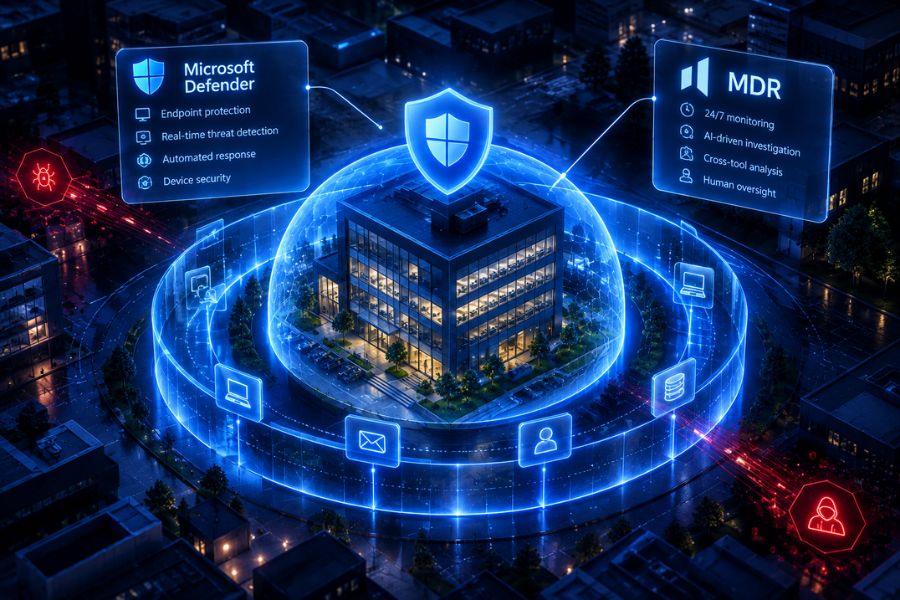
Cyber insurance requirements in the UK commonly focus on how well a business protects its systems, detects threats and responds to incidents. Insurers may ask about multi-factor authentication (MFA), endpoint protection, tested backups, staff training and who investigates security alerts.
For small and medium-sized businesses (SMEs), having these controls in place is important. Being able to demonstrate how they operate is equally valuable.
Managed Detection and Response (MDR) can support this process by providing ongoing security investigations and documented response activity. However, it does not replace essential security controls or guarantee insurance eligibility.
What Do UK Cyber Insurers Usually Ask?
Cyber insurance questionnaires vary between providers, industries and levels of cover.
The questions generally help insurers understand the risks an organisation faces and the measures it has taken to reduce them.
Common areas include:
- Multi-factor authentication: Is MFA enabled for important accounts, remote access and administrative users?
- Endpoint protection: Are company devices protected against malware and suspicious activity?
- Security updates: Are operating systems and applications regularly patched?
- Backups: Are important files backed up securely, and has restoration been tested?
- Employee awareness: Do employees receive training on phishing and suspicious communications?
- Incident response: Who investigates alerts, contains threats and coordinates recovery?
An insurer may also request information about previous incidents, outsourced security providers or compliance certifications.
The National Cyber Security Centre’s cyber insurance guidance recommends understanding both the protection available and the responsibilities that remain with your organisation.
What Evidence Should You Prepare for a Cyber Insurance Questionnaire?
A useful approach is to match each security control with evidence showing how it is maintained.
| Insurer question | Evidence to prepare | Where MDR helps | What MDR does not replace |
| Is MFA enabled? | Identity settings and access policies | Investigates suspicious authentication activity | Configuring MFA across every account |
| Are devices protected? | Endpoint coverage reports | Investigates endpoint threats | Installing and maintaining protection on all devices |
| Are backups tested? | Backup logs and restoration test records | May investigate incidents involving affected systems | Backup creation and recovery testing |
| Who investigates alerts? | Monitoring procedures and investigation records | Provides managed investigation and response | Business decisions requiring management approval |
| Are staff trained? | Training records and phishing awareness policies | Investigates suspicious email activity | Employee training programmes |
| Are incidents documented? | Incident logs and response reports | Records security investigations and actions | Legal, regulatory and insurance reporting obligations |
This checklist can help businesses identify missing documentation before an insurance application or renewal.
Organisations with no internal security team may particularly benefit from assigning clear responsibility for gathering and maintaining these records.
Who Responds to Security Alerts, and How Quickly?
An important question for any business is what happens when a security alert appears outside normal working hours.
Security tools can identify suspicious activity, but unresolved alerts may still require investigation.
An insurer may want to understand:
- Whether security monitoring continues overnight and at weekends.
- Who reviews critical alerts.
- Whether the organisation has an incident response procedure.
- Who can authorise containment actions.
- How investigations and decisions are documented.
MDR addresses the investigation and response responsibilities within the scope of the contracted service.
For example, an unusual login combined with suspicious endpoint activity may require information from several systems before the threat can be assessed.
Our guide explains how an investigation record develops from the initial alert through to the response decision.
Businesses should ask providers to explain exactly what counts as acknowledgement, investigation and containment rather than relying on a single response-time claim.
Can Cybersecurity Best Practices Reduce Cyber Insurance Premiums?
Strong cybersecurity practices reduce a business’s exposure to cyber threats and can help it secure more favourable cyber insurance terms.
Insurers assess a range of factors when calculating premiums, including business size, industry, claims history, the level of cyber risk and the security controls in place.
Measures such as multi-factor authentication (MFA), endpoint protection, vulnerability management, security awareness training, regular backups and continuous security monitoring help demonstrate that a business is actively managing its cyber risk.
Managed Detection and Response (MDR) is one part of this broader security strategy. It provides continuous monitoring, threat detection and incident response, helping businesses identify suspicious activity earlier and respond to potential incidents more effectively. It also creates a documented record of how threats were investigated and handled, which supports the evidence insurers ask for.
Some insurers take specific security controls into account when assessing applications, determining eligibility or offering premium discounts. However, the impact varies between insurers and policies, and implementing security best practices does not guarantee lower premiums.
The Association of British Insurers explains that cyber insurance provides financial protection and support following certain incidents, while businesses must continue managing their security risks. In other words, cyber insurance should complement, rather than replace, a strong cybersecurity programme.
Businesses should speak directly with their broker or insurer about the evidence required for their application.
How Can MDR Investigation Records Help at Renewal or During a Claim?
Security records help organisations demonstrate what happened before, during and after an incident.
Useful evidence may include:
- The time suspicious activity was identified.
- Security systems involved in the investigation.
- Actions taken to contain or investigate the threat.
- Approval records for sensitive actions.
- Incident summaries and follow-up recommendations.
These records can support internal reviews and help businesses respond to information requests from insurers.
For example, if an employee account is compromised following a phishing incident, investigation records can help establish the sequence of events and the response taken.
However, documented investigations do not automatically establish coverage or guarantee acceptance of a claim.
Businesses must still follow their policy’s notification requirements and provide any additional information requested by their insurer.
How Does Cyber Essentials Relate to Cyber Insurance?
Cyber Essentials is a UK government-backed certification scheme focused on five fundamental technical security controls.
Certification can help businesses demonstrate that they have implemented a recognised security baseline.
There is also an insurance benefit for eligible organisations.
According to IASME, organisations that achieve Cyber Essentials certification may receive cyber liability insurance arranged through the scheme when they meet the eligibility conditions.
These include:
- Certification covering the entire organisation.
- Being domiciled in the UK or Crown Dependencies.
- Annual turnover below £20 million.
- Opting into the insurance offering.
The included policy currently provides a £25,000 limit of indemnity, subject to its terms, exclusions and conditions.
This is separate from purchasing a standalone cyber insurance policy, which may offer different coverage and requirements.
Cyber Essentials certification does not remove the need for ongoing monitoring, effective backups or a suitable incident response process.
How Does HOPLONai Support Security Monitoring and Evidence?
HOPLONai’s Agentic MDR service combines connected security tools with AI analysts that monitor and investigate threats continuously.
It works with existing security technologies and provides additional modules where protection gaps exist.
HOPLONai’s Governance Gates determine which agentic actions can run automatically and which require human approval.
The audit log of every action supports oversight and provides a record of security activity.
HOPLONai also supports compliance evidence and readiness activities for frameworks including ISO 27001, SOC 2 and Cyber Essentials.
These capabilities can help businesses organise security information relevant to insurance discussions, while insurers remain responsible for their own underwriting and claims decisions.
Frequently Asked Questions
Do Cyber Insurers Require MDR or Just EDR?
Requirements vary between insurers and policies. Some may ask specifically about endpoint detection and response (EDR), continuous monitoring or managed response, so businesses should confirm exactly what their insurer expects.
Will MDR Reduce My Cyber Insurance Premium?
MDR may support a stronger security risk profile, but any premium adjustment depends on the insurer’s assessment. Businesses should not assume that an MDR subscription automatically qualifies them for a discount.
What Happens if We Have a Cyber Incident Without Monitoring?
An incident may go undetected for longer or require additional investigation after discovery. Insurance coverage will depend on the policy terms, the circumstances of the incident and whether the business has met its contractual obligations.
Does Cyber Essentials Help With Cyber Insurance?
Yes. Cyber Essentials demonstrates a recognised set of security controls and eligible certified organisations can opt into insurance arranged thr