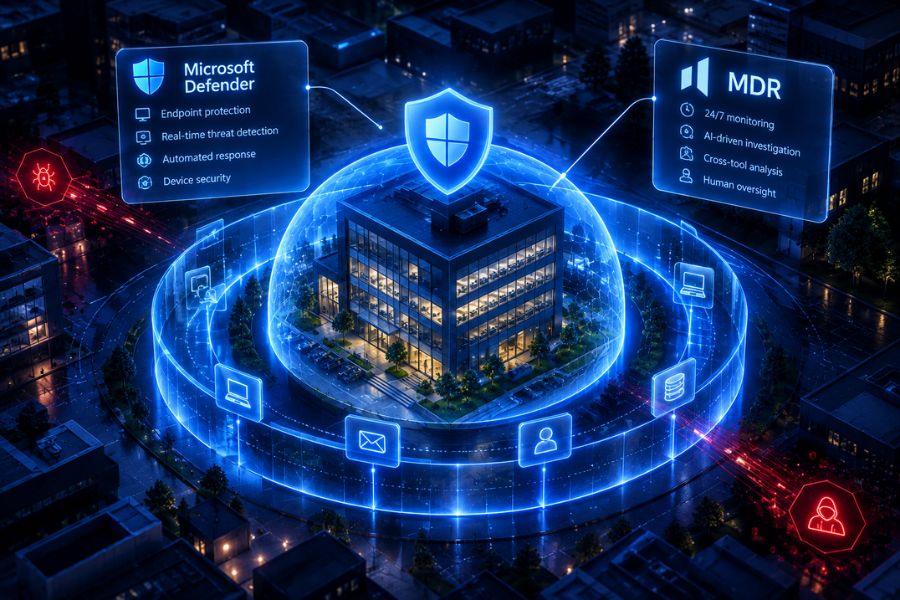
Choosing between MDR providers that call themselves agentic starts with three questions: what can their AI analysts investigate on their own, what evidence supports each verdict, and when must a person approve an action? This MDR buyer’s guide turns those questions into an 11-question checklist, a scoring table and a two-to-four-week proof-of-concept plan for lean IT teams.
It builds on our five questions to ask any MDR provider and our guide to what small businesses should look for in MDR, adding the tests that matter once AI is doing the investigating.
The short version:
- Ask to see a complete investigation on scenarios from your own environment, not a scripted demo.
- Check the controls: which actions run automatically, which need approval, and who is accountable when something goes wrong.
- Test before you commit, with a short proof of concept or a structured demo, and score every provider the same way.
Why Are Agentic MDR Providers Hard to Compare?
The word agentic is now used for security products with very different capabilities. Some use AI to summarise alerts. Others enrich events with extra context. The most capable investigate incidents across connected security tools, decide what to check next and support response actions.
The difference matters, because an alert summary still leaves someone on your team to do the investigation.
Agentic MDR (agentic managed detection and response) is a security service in which AI analysts monitor a business’s systems 24/7, investigate and connect alerts across its security tools, and take action to stop threats, with a person approving anything high-risk.
Demos don’t settle the question either. The UK National Cyber Security Centre (NCSC) notes in its research problem book that an autonomous cyber defence system that performs well in a benchmark or demonstration may behave differently in a live environment, with incomplete data, ambiguous evidence or an adversary trying to mislead it. That is why this guide ends with a test on your own scenarios.
11 Questions to Ask Agentic MDR Providers
Use these in your first conversation with each provider:
1. Which security alerts can your AI analysts investigate from start to finish on their own?
2. Can you demonstrate a complete investigation using evidence from several of our tools?
3. What percentage of alerts receives an AI investigation, and how do you measure it?
4. Which response actions require human approval?
5. What happens when approval is needed outside working hours?
6. Can we review the reasoning and evidence behind every AI decision?
7. Which of our existing security tools can you connect to, and what can each connection do: read, investigate or respond?
8. Who is accountable if an automated response interrupts business operations?
9. What reporting will our team receive after an incident?
10. Can we test these capabilities before committing, through a pilot or a demo on our own scenarios?
11. When you detect a threat at one customer, do you hunt for it across every other customer, including those running different security vendors?
Agentic MDR Evaluation Checklist: How to Score Each Provider
Score every provider against the same six criteria:
| Criterion | What good looks like | Red flag | Score (1–5) |
| Autonomy | Named alert types investigated end to end, with an example of each | “AI-powered” means alert summaries only | |
| Evidence | A full record behind every verdict: the alert, context from other tools, a timeline and the reasoning, exportable for audits | Verdicts with no supporting evidence | |
| Control | Clear rules for which actions run automatically, which need approval and what happens out of hours | Can’t say which actions need approval | |
| Coverage | Your existing tools connected, with read, investigate and respond rights stated for each | Asks you to replace tools without explaining why | |
| Accountability | Responsibility for automated actions written into the contract, plus a documented process for reviewing mistakes | No incident review or accountability process | |
| Cross-customer protection | Threats caught at one customer are hunted across all others, whatever vendor they run | Each customer protected in isolation |
Score each criterion from 1 (claimed but not shown) to 5 (demonstrated on your own data). As a rule of thumb, a provider scoring below 3 on evidence or control isn’t ready to take actions in your environment.
How to Run a Two-to-Four-Week Agentic MDR Proof of Concept
A proof of concept (PoC) shows whether a provider can deliver its claims in your environment. If a provider doesn’t offer a pilot, ask for a structured demo built on your own historical alerts or safely simulated scenarios.
Week 1: Connect and Configure
Choose two or three existing security tools, confirm permissions and set approval rules. Agree in advance what a successful investigation must show.
Week 2: Test Real Scenarios
Replay historical alerts or run safely simulated incidents. Include routine activity, suspicious behaviour and at least one scenario that needs human approval.
Weeks 3–4: Review and Measure
Walk through three complete investigations with the provider and measure:
- Time to verdict: how long it takes from alert to finished investigation. Compare it with the mean time to detect (MTTD) and mean time to respond (MTTR) of your current process.
- Review effort: how many minutes your team spends checking each finding.
- Accuracy: false positives, and any genuine threats the service missed.
- Control: whether approvals were triggered when they should have been.
Finish with a short evaluation covering investigation quality, workload, integration limits and open questions. Ask each provider for its own time-to-verdict figures and how they were measured, then check them against what you saw.
What Are the Red Flags When Comparing MDR Providers?
Be cautious if a provider:
- Cannot show the evidence behind an AI-generated verdict.
- Describes forwarding an alert by email as a complete response.
- Requires replacing existing security tools without explaining why.
- Cannot say which actions require human approval.
- Has no clear incident review or accountability process.
- Treats a scripted demo as proof and won’t test on your scenarios.
The NCSC’s guidance on choosing a managed service provider advises checking transparency, clearly defined roles and responsibilities, how incidents are notified and managed, and regular review and reporting. Those checks apply equally to an AI-driven service. For the AI itself, the NIST AI Risk Management Framework (AI RMF 1.0, currently being revised) lists accountability and transparency among the characteristics of trustworthy AI.
How Does HOPLONai Answer This Checklist?
Here is how HOPLONai’s Agentic MDR maps to the six criteria:
- Autonomy: AI analysts start investigating as soon as an alert arrives, pulling in context from other tools, such as every other device where a suspicious file has appeared. In internal HOPLONai testing, an investigation that takes a human analyst around 45 minutes was completed in under five minutes.
- Evidence: every investigation is documented, and Governance Gates keep a full audit log of every proposed and completed action. See how an investigation unfolds.
- Control: HOPLONai supports 16 agentic action types, each assigned a risk category. Low-risk actions can run automatically, higher-risk actions wait for one-click approval in tools such as Slack, and nothing is remediated unless you turn it on. Read more about Governance Gates.
- Coverage: HOPLONai connects to tools such as CrowdStrike, SentinelOne, Microsoft Defender, Microsoft 365 and Google Workspace (see all integrations), and its own modules fill any gaps.
- Accountability: any action can be tested in dry-run mode before it goes live, and every proposed and completed action is logged for review.
- Cross-customer protection: when any security tool catches a threat at one HOPLONai customer, HOPLONai hunts it down and removes it for every other customer, whatever vendor they run.
You can start on HOPLONai’s free-forever tier and add paid protection and the AI analysts when you’re ready. See HOPLONai pricing for what each package includes.
Frequently Asked Questions
What Should an MDR Buyer’s Guide Cover?
Autonomy (what the AI investigates alone), evidence (the record behind each verdict), control (which actions need human approval), coverage (which existing tools it connects to) and accountability (who owns a wrong automated action). For AI-driven services, add a test on your own scenarios.
What Makes an MDR Provider Truly Agentic?
A genuinely agentic service uses AI analysts that investigate security events, gather information across tools and decide on next steps. Ask for completed investigations rather than relying on product descriptions.
Who Is Accountable When AI Makes a Mistake?
Accountability should be defined in the service agreement and your internal security policies. Agree responsibilities for automated actions, approvals, incident reviews and remediation before deployment.
Can I Keep My Existing Security Tools?
Many Agentic MDR services integrate with existing security products, although supported capabilities vary. Confirm whether each integration supports monitoring, investigation and response.
How Long Should an Agentic MDR Proof of Concept Take?
Two to four weeks is usually enough for a focused evaluation involving a few tools and representative scenarios. Larger or more complex environments may need longer.
What Should an Agentic MDR Demo Show?
A useful demo follows an incident from the first alert through evidence gathering, investigation, decision-making and response, ideally on scenarios from your own environment. It should also show approval controls, investigation records and what your IT team would see.
See How Agentic MDR Works With HOPLONai
Choosing an Agentic MDR provider is an important security decision, especially when your team has limited time to investigate threats.
HOPLONai helps businesses connect their existing security tools, investigate suspicious activity and manage security actions with appropriate human oversight.
Want to test these criteria in practice? Book an Agentic MDR demo with HOPLONai and see how AI security analysts can support your organisation.