Small business cyber attacks in the UK often exploit familiar weaknesses, including phishing emails, compromised accounts, outdated software and security alerts that nobody investigates. Many of these risks can be reduced with straightforward security measures, but smaller organisations may lack the time or resources to maintain them consistently.
The UK government’s latest Cyber Security Breaches Survey shows that smaller businesses continue to face substantial cyber risks, despite growing awareness of the problem.
What Does the 2026 UK Cyber Security Breaches Survey Show?
The government’s Cyber Security Breaches Survey 2025/2026, published in April 2026, provides a picture of the threats facing UK organisations.
Its findings include:
- 43% of UK businesses reported identifying a cyber security breach or attack in the previous 12 months.
- 46% of small businesses identified a breach or attack, compared with 42% of micro businesses.
- 38% of all businesses reported experiencing phishing attacks.
- Among small businesses, 41% conducted cyber security risk assessments, down from 48% the previous year.
The survey also found declines in the proportion of small businesses maintaining formal cyber security policies and business continuity plans covering cyber incidents.
These findings suggest that awareness alone does not always translate into consistent protection.
The survey measures attacks and breaches that organisations identified. Businesses with limited monitoring capabilities may not detect every incident affecting their systems.
Which Basic Cyber Attacks Still Work Against Small Businesses?
Many common cyber threats rely on familiar weaknesses rather than sophisticated techniques.
Phishing and Stolen Credentials
Attackers send convincing emails designed to steal passwords, deliver malicious files or persuade employees to disclose sensitive information.
A compromised account can provide access to business email, cloud documents and other connected services.
Effective phishing triage helps organisations investigate suspicious messages and identify related security activity.
Account Takeovers Without MFA
Passwords alone may be insufficient when attackers obtain credentials through phishing or previous data breaches.
Multi-factor authentication (MFA) adds an additional verification step, making unauthorised access more difficult.
Unpatched Devices and Applications
Outdated operating systems, browsers and business applications may contain known vulnerabilities.
Attackers can exploit these weaknesses when security updates are delayed or devices are no longer supported.
Supplier and Email Impersonation
Attackers may impersonate suppliers or business contacts to request payments, change banking details or obtain confidential information.
These scams often succeed because messages appear to come from trusted organisations.
Why Do Small Businesses Keep Experiencing These Problems?
Limited resources are a major challenge.
In many SMEs, cybersecurity is managed by the same person responsible for everyday IT support, software updates and employee accounts.
Some businesses have no internal security team at all.
Other organisations already have endpoint protection, email filtering and cloud security tools, but struggle to monitor everything consistently.
Having too many tools can also make it difficult to understand which alerts require attention.
Security practices may receive attention during initial setup, then gradually become outdated as employees, devices and applications change.
Without clear responsibility and regular reviews, small problems can remain unresolved.
What Five Steps Can Small UK Businesses Take to Improve Security?
The National Cyber Security Centre provides practical guidance that businesses can apply without building a large internal security department.
1. Enable Multi-Factor Authentication
Require MFA for business email, cloud applications, administrator accounts and other important systems.
Prioritise phishing-resistant authentication methods where supported.
2. Keep Software and Devices Updated
Enable automatic security updates wherever practical.
Review unsupported devices and applications, and ensure important security patches are installed promptly.
3. Follow Cyber Essentials Controls
The UK government’s Cyber Essentials scheme provides a recognised baseline for protecting organisations against common internet-based threats.
Its five technical controls cover firewalls, secure configuration, security update management, user access control and malware protection.
Businesses considering certification can also review which security standard to start with.
4. Maintain and Test Backups
Keep protected backups of important business information.
Regularly test whether data can be restored, and ensure backup access is appropriately secured.
Backups support recovery when files are deleted, encrypted or made unavailable.
5. Make Sure Someone Investigates Security Alerts
Security monitoring should continue after tools have been installed.
Organisations need a clear process for reviewing alerts, investigating suspicious activity and escalating important incidents, including outside normal working hours.
This becomes particularly important when internal IT resources are limited.
Where Does Agentic MDR Fit for Businesses Without a Security Team?
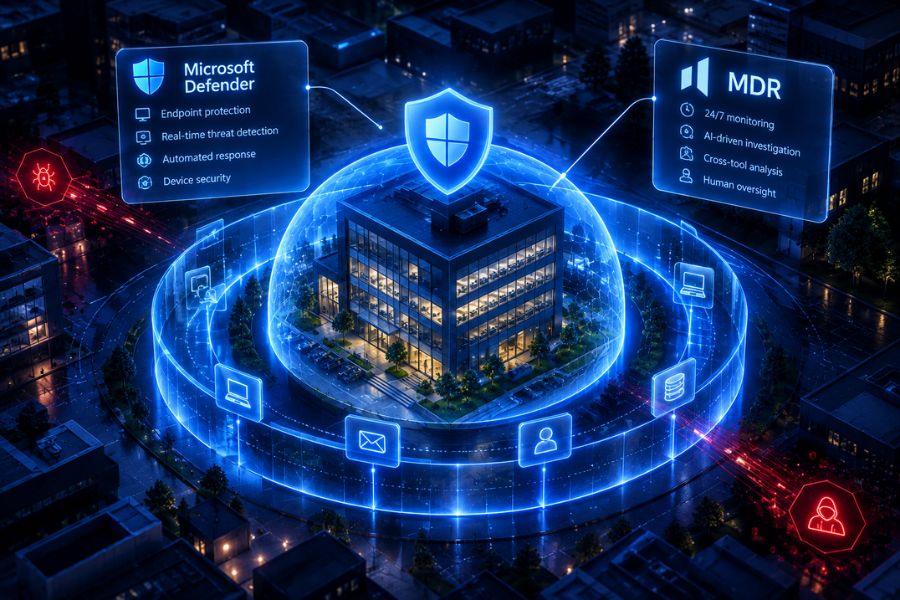
Agentic MDR (agentic managed detection and response) provides continuous security monitoring and investigation through AI analysts working across connected security tools, with human approval for higher-risk actions.
For growing businesses, this can help reduce the investigation workload placed on internal employees while improving visibility across security systems.
Agentic MDR complements essential protections such as MFA, software updates and backups. Those controls remain important regardless of the monitoring service in place.
Frequently Asked Questions
Are Small Businesses Really Targeted by Cyber Criminals?
Yes. The UK Cyber Security Breaches Survey 2025/2026 found that 46% of small businesses identified a cyber security breach or attack during the previous year. Company size does not eliminate exposure to phishing, account compromise or other common threats.
Is Cyber Essentials Enough to Protect a Small Business?
Cyber Essentials establishes an important baseline against common cyber threats. However, businesses still need effective monitoring, incident response procedures, backups and ongoing security management.
What Is the Most Common Cyber Attack on UK Small Businesses?
Phishing is the most commonly reported type of cyber attack among UK businesses. It often involves deceptive messages designed to steal credentials, deliver malicious content or manipulate employees.
What Should a Small Business Do First to Improve Cybersecurity?
Start by securing important accounts with MFA, updating devices, checking backups and ensuring employees know how to report suspicious activity. A basic risk assessment can help identify the most urgent gaps.
Does a Small Business Need to Hire a Security Analyst?
Not necessarily. Businesses can combine appropriate security tools with external expertise or managed security services, depending on their size, risks and available resources.
Building Stronger Cybersecurity Without a Large Internal Team
Small businesses can make meaningful improvements by maintaining essential controls, assigning clear responsibility and ensuring security incidents are investigated.
For organisations that need continuous monitoring without building an internal security operations centre, understanding Agentic MDR is a useful next step.