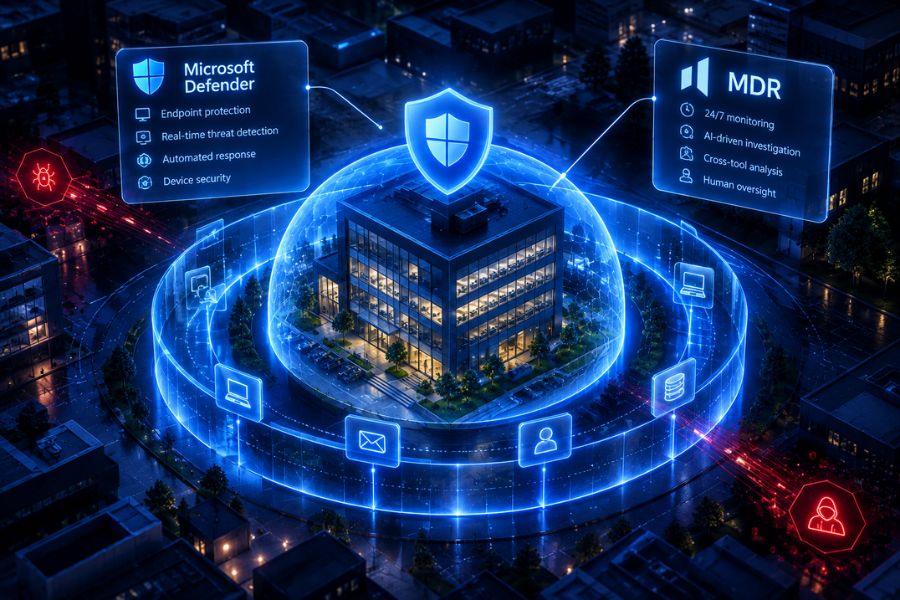
Autonomous threat response allows AI Security Agents to investigate threats and take predefined actions without requiring a human to perform every step. Depending on their permissions, these agents can gather evidence, scan devices, recommend remediation, and initiate security actions.
As businesses adopt Agentic MDR (Managed Detection and Response), an important question emerges: how much control should AI Security Agents have over security systems?
The answer depends on the potential impact of each action and the safeguards available to manage it.
What Is Autonomous Threat Response?
Autonomous threat response uses AI Security Agents to analyse security events and determine appropriate actions based on available evidence and security policies.
For example, when an endpoint security tool detects suspicious activity, an AI Security Agent may:
- Investigate the affected device.
- Collect related alerts and threat intelligence.
- Check whether other systems show similar activity.
- Assess the severity of the potential threat.
- Recommend or initiate a response based on its permissions.
These capabilities are increasingly important for organisations using Managed Detection and Response to support continuous security operations.
Which Security Actions Can AI Security Agents Perform?
AI Security Agents can support several stages of threat investigation and response. However, different actions carry different levels of operational risk.
1. Low-Risk Investigation Tasks
These are generally suitable for higher levels of automation.
Examples include:
- Collecting security logs.
- Analysing suspicious files or indicators.
- Gathering device information.
- Correlating alerts across security tools.
- Producing incident summaries.
These tasks help teams understand a potential threat without directly changing the affected environment.
2. Security Actions That Change Systems
Some responses can affect employees, devices, or business operations.
Examples include:
- Isolating a potentially compromised endpoint.
- Blocking a suspicious IP address or email accounts.
- Disabling a user account.
- Quarantining a device or a potentially malicious file.
Although these actions can stop threats from spreading, an incorrect decision may interrupt legitimate business activity.
Organisations should therefore define which actions can run automatically and which require approval.
Why Does Human Oversight Matter?
AI Security Agents can analyse information quickly, but they may not always have the full business context behind an event.
A suspicious login might be an attacker attempting to access company data. It could also be an employee travelling abroad.
Similarly, isolating a device might contain a threat, but it could also disrupt an important business process.
Human oversight helps organisations maintain control over sensitive decisions.
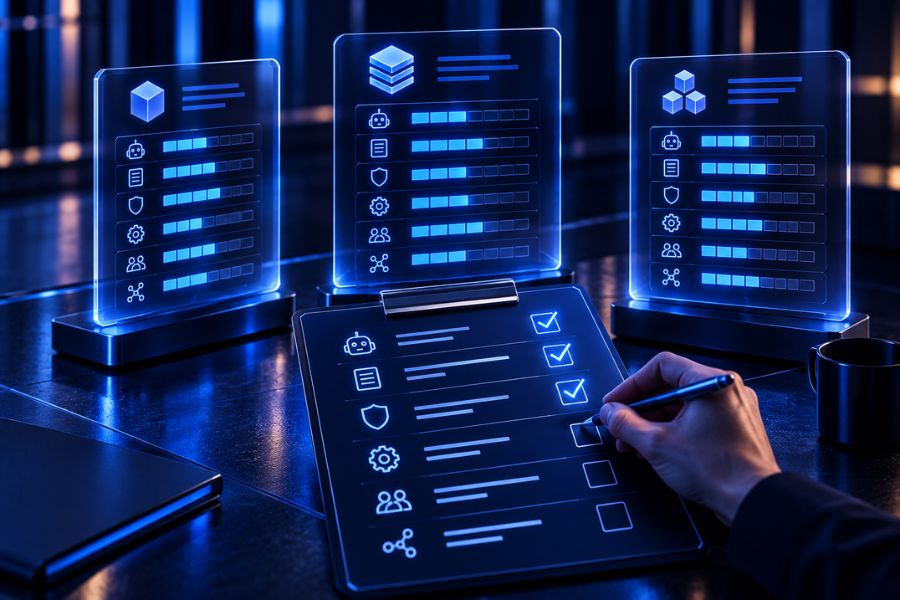
A well-designed autonomous response system should provide:
- Clear permissions for individual actions.
- Approval requirements for higher-risk changes.
- Visibility into the evidence behind decisions.
- Complete records of actions and approvals.
- The ability to test proposed responses before execution.
This balance is particularly important for SMEs and lean IT teams that need stronger security without introducing unnecessary operational risk.
How HOPLONai Uses Governance Gates
HOPLONai’s Agentic MDR architecture includes Governance Gates, a control layer that determines what AI Security Agents are authorised to do.
Each agentic action is mapped to a risk category and guardrail tier.
Governance Gates provide:
- Automatic execution: Authorised actions can run without manual approval.
- Human approval: Higher-risk actions can require explicit authorisation.
- Audit logs: Proposed and completed actions are recorded.
- Dry-run mode: Teams can review intended actions before execution.
- Capability checks: Agents verify whether connected security tools support an action.
- Opt-in remediation: Organisations control whether remediation capabilities are enabled.
HOPLONai currently supports 38 agentic actions across seven security modules. Endpoint security alone has nine, including scan, contain and investigate:
| Module | Available actions |
| Endpoint Security | 9 |
| Email Security | 5 |
| Cloud / DLP | 3 |
| Browser Security | 11 |
| Case Management | 3 |
| Collaboration | 2 |
| Platform Admin | 5 |
| Total | 38 |
These controls help teams use AI-driven response while maintaining appropriate oversight.
For a broader explanation of this operating model, explore Agentic MDR vs AI SOC: What Lean Teams Actually Need.
How Can Businesses Adopt Autonomous Threat Response Safely?
Businesses evaluating autonomous security operations should begin with clear rules.
Start by identifying low-risk investigation tasks that can be automated. Next, define approval requirements for actions that affect users, devices, or critical systems.
Review audit logs regularly and test response workflows before enabling broader automation.
It is also important to connect information across existing tools. Understanding related security events helps agents make better-informed decisions and supports efforts to reduce security alert fatigue.
Bringing Automation and Control Together
Autonomous threat response can improve investigation speed and reduce repetitive work. Its effectiveness depends on accurate information, clearly defined permissions, and appropriate human oversight.
HOPLONai combines Agentic MDR capabilities with Governance Gates to help businesses investigate threats, prioritise risks, and manage security actions across their environments.
Want to see how AI Security Agents operate with built-in safeguards? Book a demo with HOPLONai and explore autonomous threat response for your organisation.